Financing and Funding
Take a look around
The Pro Forma
Between climbing construction costs, a shortage of construction workers, changing interest rates, tariffs, and other factors, funding a development project in the Western U.P. can be complex as well as expensive. This often means that a developer will have to find a diverse set of funding sources to finance their project.
Funding Sources
Tax Tools
Tax Credit Programs
Lenders
The financial structure details who will get paid back, in what order, and how much risk each party carries. This is also known as the capital stack (Figure 6). The capital stack is composed of four main layers: developer or partner investment (“common equity”), preferred equity, mezzanine debt, and senior debt, listed in order from lowest to highest priority. That means that senior debt is paid off first, then mezzanine debt, then preferred equity, and finally, common equity lenders are paid last.
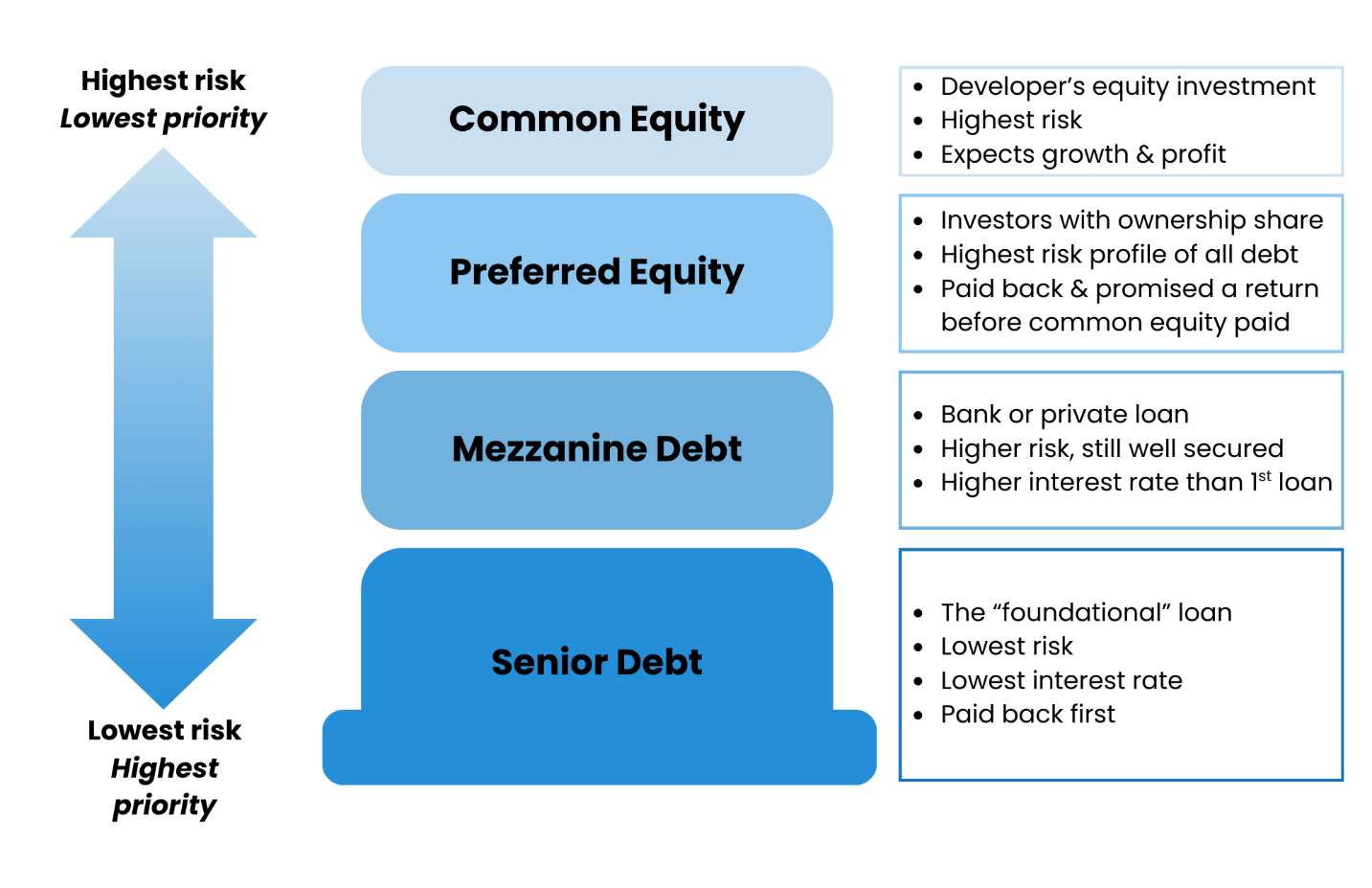
Creating the capital stack for a project can be complicated and time consuming. The capital stack should be part of the feasibility study of a project.
A useful tool for assessing a project’s financing and funding feasibility is the pro forma, a document outlining all the major aspects of a project’s financing.
The pro forma
The pro forma is a crucial analysis outlining a project’s financial feasibility. This analysis aims to organize the entire project’s budget, including its projected revenue and expenses and potential funding sources.
Typical elements of the pro forma:
Sources and uses
Cash flow analysis
Profit and loss
Sources and uses
The sources and uses section of a pro forma, sometimes referred to as a balance sheet, will include “sources” of funds, including grants, loans, and equity in the project, and “uses” of funds, or costs—from property acquisition to the completion of construction.
Sources of funds will include the various components of the capital stack, including senior debt, mezzanine debt, preferred and common equity.
The total development costs will include acquisition costs (purchase of the property), hard costs (site preparation, construction, etc.), and soft costs (design work, interest paid on loans, taxes, and more). Note that grant programs often differ in which of these costs are eligible for funding through their programs.
For a project to be feasible, the sources must match or exceed your uses. If total sources amount to less than total uses, the project has what is called a “financing gap”.
Cash flow analysis
The cash flow analysis is analogous to the sources and uses but considers what happens after the development is complete. This analysis tests whether the project will have enough cash incoming, or revenue, to cover ongoing operating expenses. An analysis over a period of five to ten years will provide a longer-term view of the project’s potential for success.
Profit and loss
The profit and loss statement or P&L section of a pro forma, reflects the expected revenue that a project will generate after construction is calculated. For rental property, the revenue sources will include monthly rents from each tenant and monthly income from parking or other fees.
Many grant programs have their own template pro forma, which will be completed as part of a grant application. We have compiled some examples below.
Pro Forma examples
Funding sources
To create housing that is attainable for Michiganders and make projects profitable, developers will generally seek public funding sources. Navigating the funding maze is complex with options ranging from federal, state, and regional grants and loan programs to tax tools like Tax Increment Financing (TIF), Payment in Lieu of Taxes (PILT or PILOT), and tax credits, as well as lender sources including traditional banks, credit unions, and Community Development Financial Institutions (CDFIs).
Fortunately, housing advocates across the state have created resources compiled in the Resources section of this guide to make the search for funding easier.
MSHDA MI Neighborhood Pro Forma (scroll to “Reference materials” to download the “New Unit Proforma” or “Rental Development Proforma”)
Finding funding is only part of the challenge—navigating application processes and managing grant programs can also be complex. Experienced professionals can assist in administering grant funds for projects.
Several agencies offer technical assistance to developers in the Western U.P., including Great Lakes Housing Services (GLHS), Invest UP, Keweenaw Economic Development Alliance (KEDA), and Western U.P. Planning & Development Region WUPPDR.
Federal, state, and regional grants and loans
There are numerous federal, state, and regional grant and loan programs available to communities, organizations, developers, contractors, and individuals in the Western U.P. Following is a brief overview of a few common grantors and their websites for up-to-date program information.
Michigan Economic Development Corporation (MEDC)
MEDC has several divisions: Business Development Services, International Trade Services, Access to Capital for Michigan Companies, and Community Development. It is also the home to Pure Michigan, the division dedicated to promoting the state’s travel industry. MEDC’s housing-related programs are within the Community Development Division. The Community Development team focuses on “creating vibrant, sustainable and unique places by providing economic development and programs to attract and retain talent in Michigan communities.”
MEDC offers grants and loans to redevelop downtowns and foster historic preservation. MEDC encourages compact mixed uses in an urban setting to reduce sprawling development. All projects must be within the MEDC’s definition of a downtown.
Learn more about MEDC’s Community Development Program
Michigan State Housing Development Authority (MSHDA)
MSHDA was established in 1966 to provide financial and technical assistance through public and private partnerships to create affordable housing, as well as economic development to create vibrant cities, towns, and villages.
MSHDA offers a wide range of programs funded by state and federal sources. These include assistance as diverse as the Housing Choice Voucher Program for rental assistance, various subsidized mortgage programs, and the MI Neighborhood grant program that supports a wide range of building rehabilitation and new construction projects.
Learn more about current MSHDA programs
United States Department of Agriculture (USDA) – Rural Development
USDA plays a major role in rural development, including housing. USDA is made up of 29 agencies and offices. It oversees and implements housing, farming, ranching, forestry, industrial, food quality and safety, and nutritional labeling programs.
USDA-RD has major areas of assistance relevant to housing: infrastructure, single-family housing, and multifamily housing grants and loans.
MI Funding Hub
The MI Funding Hub is an online search tool which helps local governments, agencies, nonprofits, businesses, and individuals connect with funding sources based on project type. Selecting “housing” in their search tool will connect you with potential funding sources.
Brownfield Redevelopment and Blight Remediation Programs
Michigan offers a range of programs to support housing development on brownfield sites and address blight in communities. The Michigan Department of Environment, Great Lakes, and Energy (EGLE) and the U.S. Environmental Protection Agency provide funding and technical assistance for environmental cleanup and redevelopment. Additionally, the Michigan State Land Bank Authority’s Blight Elimination Program helps stabilize vacant buildings to prevent further deterioration, preserving them for future rehabilitation and reuse, including housing.
InvestUP
InvestUP is the Upper Peninsula-wide private sector economic development organization. Its Build U.P. program was launched to address the need of housing across the U.P. and provide a long-term, sustainable fund to help solve future housing challenges. Build U.P. offers a variety of financial support to lenders, municipalities, and developers for housing projects, with a goal to grow the population of the Upper Peninsula. The four current programs serve the following purposes (subject to numerous conditions and vetting by the Build U.P. Board):
Cash Collateral Program provides cash collateral to enhance U.P. lending institution funding. Recipients must partner with a local lending institution to access funds. Funds may cover all or a portion of a calculated shortfall (as described by the lending institution).
Equity Participation Program invests equity into qualified housing projects when a lender determines that real cash equity from the Borrower is insufficient to finance the construction of the project.
Residential Infrastructure Loan Program provides financial assistance to cities, villages, counties, and townships to facilitation infrastructure extensions to new residential or rehabilitated housing. Build U.P. will loan the local unit of government funds by purchasing their bonds at interest rates favorable to the local unit.
Tax tools
Tax abatement and capture programs
TIF allows a developer to be reimbursed for costs related to an eligible property (contaminated, functionally obsolete, or blighted) by the incremental increase in property taxes resulting from new development
Example of TIF Process
Final taxable value (at end of project)
$5,000,000
Pre-project (base year) taxable value
- $3,000,000
“Captured” taxable value (increment)
$2,000,000
Property tax rate (36 mills)
0.036
Tax increment revenue (amount available for developer reimbursement)
$72,000
MSHDA Housing Tax Increment Financing (TIF)
Eligible properties for the MSHDA Housing TIF are properties on which 1 or more units of residential rental housing are proposed to be constructed, rehabilitated, or otherwise designed to be used as a dwelling; or one or more units of residential housing proposed to be constructed or rehabilitated and located in a mixed-use project. This program is available for properties that do not claim a principal residence exemption (PRE). An eligible property is non-PRE (non-homestead).
For additional information see MSHDA’s Housing Tax Increment Financing (TIF) Program:
MSHDA Housing Tax Increment Financing (TIF) Program
Act 381 Tax Increment Financing
The full Housing TIF Program Statement can be found at the following link:
A program administered by Michigan’s Department of Environment, Great Lakes, and Energy (EGLE), this program helps revitalize abandoned, contaminated, or otherwise challenged properties to return them to the tax rolls, attract developers to brownfields, creating jobs and investment, and increase nearby property values and more. For housing projects through EGLE’s Brownfield TIF, the support of 100% residential projects depends on a number of factors including but not limited to:
Type and level of contamination
How contamination is being addressed
Type of residential development
Reliable control of site activities
Housing TIFs are project specific and do not cover a particular district. A local TIF, recodified in Michigan Public Act 57 of 2018, is a public financing tool used by local governments to fund projects in an area with specific designated boundaries for redevelopment, public infrastructure, environmental cleanup, historic property rehabilitation, and new commercial development.
For additional information on EGLE’s Brownfield TIF, see the following website:
Land Banks
The State Land Bank Authority (SLBA) facilitates reuse of land to bring the property back on the tax rolls. The SLBA also supports county and local land banks across the state. Opportunities include Blight Elimination programs that help with the reuse of blighted structures. For more information and links to local land banks, see the link below:
LEO - State Land Bank Authority
All counties in the region except Iron have county-level land banks. For more information, contact the respective county’s treasurer’s office.
Local units of government and qualified housing developers in Michigan can get help developing property in their inventory for housing with support from the SLB Housing Development Loan program. For more information, follow the link to the SLBA webpage:
Downtown Development Authorities (DDA)
DDAs can use TIFs within a specific delineated area to capture the year-to-year growth in property values and reinvest those dollars in “public facilities” as defined by PA 197 of 1975 and PA 57 of 2018. DDA TIFs are regulated by the Department of the Treasury and can be used for:
Infrastructure Improvement projects such as streetscapes, street lighting, floodwall protection, parks and open space
Catalytic Projects
Historic Preservation
Marketing & Promotions
Payments in Lieu of Taxes (PILOTs)
A local unit of government can support affordable housing developments by approving Payments in Lieu of Taxes for projects that include affordable units. The PILOT allows the property to pay a set service charge instead of ad valorem taxes on eligible low-income housing units. A Payment In Lieu of Taxes (PILT or PILOT) is a temporary, partial reduction in future real and/or personal property taxes granted in exchange for a commitment to community-benefiting projects that would not occur without the incentive. These projects often include developments such as low-income housing and are designed to support local needs while encouraging investment.
Neighborhood Enterprise Zone (NEZ)
A Neighborhood Enterprise Zone Act allows for tax exemption for development and rehabilitation of residential housing located within core communities.
NEZ freezes property taxes at pre-development/pre-construction rate for end users for periods up to 15 years. A local government can establish a NEZ in an eligible distressed area. This tool promotes neighborhood revitalization.
New and rehabilitated facilities applications are filed, reviewed, and approved by the local unit of government (LUG), but are also subject to review at the state level by the state. The State Tax Commission (STC) Property Services Division is responsible for final approval and issuance of new and rehabilitated facility certificates.
Obsolete Property Rehabilitation
The Obsolete Property Rehabilitation Act (OPRA) provides property tax exemptions for eligible commercial and commercial housing properties that undergo rehabilitation within a designated Obsolete Property Rehabilitation District and meet requirements of the act. Local governments determine the exemption period, which can range from 1 to 12 years, while the State Tax Commission grants final approval and issues OPRA certificates. Note that new exemptions will not be granted after December 31, 2026.
Tax credit programs
Low Income Housing Tax Credits (LIHTC)
Enacted as part of the Tax Reform Act in 1986, LIHTC are federal tax incentives designed to promote the development and rehabilitation of affordable rental housing for low-and moderate-income tenants. It is administered by the IRS and allocated to states based on population. The two main types of credit are 9% credits, used for new construction projects and 4% credits that involve acquisition and rehabilitation.
LIHTC is a much-sought-after incentive, but availability of credits is much less than the demand, and historically the scoring criteria for granting of credits has been unfavorable toward rural projects; however, this has been on an improvement trend in recent years.
New Market Tax Credits (NMTC)
New Market Tax Credits (NMTC) is a federal program that encourages private investment in low-income communities by offering federal income tax credits to individuals or corporations that make equity investments in Community Development Entities (CDEs). Developments must include at least 20% commercial and 80% residential property use based on revenue. Generally used in large scale projects, NMTC can be combined with historic rehabilitation tax credits, but cannot be paired with Low-Income Housing Tax Credits (LIHTC). For more information on New Market Tax Credits see:
Historic Tax Credits
Federal and state Historic Tax Credits can be powerful tools for financing the rehabilitation of historic buildings, and both can be used on the same project. The federal and state programs operate independently, each with their own application process, eligibility criteria, and approval timeline. Note that qualifying for one does not guarantee approval for the other.
The Federal Historic Tax Credit offers a 20% income tax credit for the rehabilitation of historic, income-producing buildings that are determined by the Secretary of the Interior, through the National Park Service, to be “certified historic structures”. The State Historic Preservation Offices and the National Park Service review the rehabilitation work to ensure that it complies with the Secretary’s Standards for Rehabilitation. Building(s) must be listed on the National Historic Register individually or contributing property(s) located in a federal or local historic district. The developer or an investor (bank, corporation, etc.) obtains a dollar-for-dollar reduction in their federal tax liability.
The State of Michigan Historic Tax Credit provides a 25% credit on qualified rehabilitation expenses for properties listed on the National Register of Historic Places or State Register or Historic Sites or individually listed or contributing to a locally designated historic district. The program has an annual cap of $5 million, divided among large commercial, small commercial, and residential projects, with no single project receiving more than $2 million per year. Credits are awarded on a first-come, first-serve basis and are applied against the applicant’s state income tax liability.
Lenders
There are three main types of lenders to consider: traditional banks, credit unions, and community development financial institutions (CDFIs).
Traditional banks are for-profit institutions—either privately owned or publicly traded—that offer a wide range of financial products and services. Banks are widely accessible, with many physical branches and ATMs; however, they typically have higher rates and fees due to their for-profit nature.
Credit unions are nonprofit, member-owned cooperatives that provide standard banking services like savings accounts, loans, and checking. Unlike conventional banks, credit unions are governed by their members, who benefit from more favorable rates and lower fees. While they may offer a narrower range of products than larger financial institutions, credit unions focus on serving their communities and prioritizing the financial well-being of their members.
The Community Development Financial Institutions Fund (CDFI Fund) was established in 1994 as part of the U.S. Department of Treasury. It supports the creation and capacity of community-based financial institutions that specialize in providing affordable credit, capital, and financial services. Along with federal grants, local CDFIs are funded by private investments and partnerships with traditional financial institutions. CDFIs are mission-driven entities that provide affordable credit, capital, and financial services to individuals and businesses in economically distressed communities. CDFIs offer support in areas that are underserved, including rural regions and urban or suburban neighborhoods where access to financing is limited. You can find a local CDFI using the Michigan CDFI Coalition search tool.
Several individual programs are within the realm of CDFIs:
Launched in 2001, the Native American CDFI Assistance (NACA) program invests in Native Communities by supporting Native CDFIs. The Bank Enterprise Award (BEA) Program provides funds to FDIC-insured banks and thrifts that increase their investment activity in communities with high poverty and unemployment rates. The CDFI Fund also administers the New Markets Tax Credit (NMTC) Program, discussed above. The Bond Guarantee Program guarantees notes or bonds issued at no cost to the federal government to support CDFI lending and investments. The Capital Magnet Fund (CMF) provides competitive grants to promote affordable housing for low-income families and communities.